


|
|
SophiaFramework UNIVERSE 5.3 |
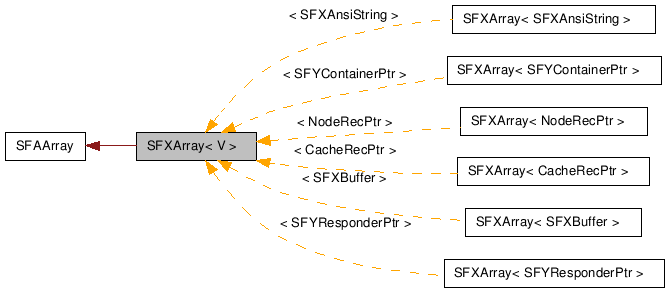
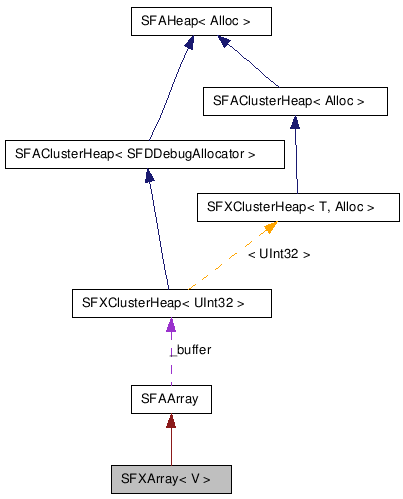
SFXArray is the data structure to store all its elements into the consecutive memory area(internal buffer) and to access its element directly using the index.
![[Note]](images/note.png) |
SFXArray and SFXList |
|---|---|
|
In the SFXArray class, an element can be directly accessed using the index. On the other hand, in the SFXArray class, accessing an element needs to be traversed via a two-way linked list. Therefore, accessing an element is faster than in the SFXList class. In the SFXList class, inserting or deleting an element is only to maintain the pointers of the element in question and the neighboring elements. On the other hand, in the SFXArray class, it is necessay to to move elements after the element in question in the internal buffer memory. Therefore, inserting or deleting an element is slower than in the SFXList class. | |
In the default settings, when the first element is inserted, the internal buffer will be allocated by the size set with the SFXArray::SetThreshold function(default: size for 4 elements). Then, in case memory becomes insufficient while elements are inserted one by one, the internal buffer will be expanded by the cluster size set with the SFXArray::SetCluster function(default: size for 8 elements). Here, the size of one element is 4 byte.
![[Caution]](images/caution.png) |
Caution |
|---|---|
|
When the internal buffer is expanded, new consecutive memory area bigger than the current one by the cluster size will be allocated and all data of existing elements will be copied there. Therefore, if expansion is performed frequently, it may become the cause of performance deterioration If the number of the elements are known in advance, it is recommended to set the internal buffer size with the SFXArray::SetThreshold / SFXArray::SetCluster functions or to set the number of the elements with the SFXArray::SetSize function(*). * If the internal buffer is expanded with the SFXArray::SetSize function, each element in the expanded area will be set to 0. | |
Each element size of SFXArray needs to be less than or equal 4 byte. In order to process data more than 4 byte ( such as UInt64 type, Float64 type, and so on ) or class instance as an element of the SFXArray instance ( array ), a pointer should be used.
// data more than 4 byte or class instance cannot be an element of the SFXArray instance ( array )

// SFXArray<SInt64> ar64;           NG
// SFXArray<SFXAnsiString> arstr;   NG

// but a pointer to the data more than 4 byte or class instance can be an element of the SFXArray instance ( array )

SFXArray<SInt64Ptr> ar64;        // OK
SFXArray<SFXAnsiStringPtr> arstr;// OK
| Constructor/Destructor |
|---|
|
SFXArray( Void ) Constructor of the SFXArray class.
|
|
SFXArray(
UInt16 threshold
, UInt16 cluster
) Constructor of the SFXArray class.
|
| Public Functions | |
|---|---|
| SFCError |
Append(
V value
) [DEPRECATED] Append an element.
|
| SFCError |
Append(
SFXArray< V > const & collection
) [DEPRECATED] Append an element.
|
| Void |
Clear( Void ) Clear this array.
|
| Bool |
Contains(
V value
) Check whether or not this array contains the specified value.
|
| static SFXArray< V > const & |
EmptyInstance( Void ) Get an empty array.
|
| Bool |
Equals(
SFXArray< V > const & collection
) Check whether or not this array equals the specified array.
|
| SInt32 |
FirstIndexOf(
V value
, SInt32 index = SINT32_MINIMUM
) Get the first index of the element that equals the specified value, searching from the head.
|
| V |
Get(
SInt32 index
) Get the element at the specified index.
|
| UInt16 |
GetCluster( Void ) Get the cluster size of the internal buffer memory. [in bytes]
|
| Enumerator |
GetEnumerator(
SInt32 index
) Get the enumerator that points to the element at the specified index.
|
| V |
GetFirst( Void ) Get the element at the head.
|
| Enumerator |
GetFirstEnumerator( Void ) Get the enumerator that points to the first element.
|
| Iterator |
GetFirstIterator( Void ) Get the iterator that points to the first element.
|
| Iterator |
GetIterator(
SInt32 index
) Get the iterator that points to the element at the specified index.
|
| V |
GetLast( Void ) Get the element at the tail.
|
| Enumerator |
GetLastEnumerator( Void ) Get the enumerator that points to the last element.
|
| Iterator |
GetLastIterator( Void ) Get the iterator that points to the last element.
|
| SInt32 |
GetSize( Void ) Get the size(the number of the elements).
|
| UInt16 |
GetThreshold( Void ) Get the minimum size of the internal buffer memory. [in bytes]
|
| SFCError |
Insert(
SInt32 index
, SFXArray< V > const & collection
) Insert the specified element or array before the specified index.
|
| SFCError |
Insert(
SInt32 index
, V value
) Insert the specified element or array before the specified index.
|
| SFCError |
InsertFirst(
SFXArray< V > const & collection
) Insert the specified element or list at the head.
|
| SFCError |
InsertFirst(
V value
) Insert the specified element or list at the head.
|
| SFCError |
InsertLast(
SFXArray< V > const & collection
) Insert the specified element or array at the tail.
|
| SFCError |
InsertLast(
V value
) Insert the specified element or array at the tail.
|
| Bool |
IsEmpty( Void ) Check whether or not this array is empty.
|
| SInt32 |
LastIndexOf(
V value
, SInt32 index = SINT32_MAXIMUM
) Get the last index of the element that equals the specified value, searching from the tail.
|
| SFCError |
Move(
SInt32 destination
, SInt32 source
) Move the element at the specified index to the specified index.
|
| SFCError |
MoveFirst(
SInt32 source
) Move the element at the specified index to the head.
|
| SFCError |
MoveLast(
SInt32 source
) Move the element at the specified index to the tail.
|
| Void |
Remove(
SInt32 index
) Remove the elements at the specified index or range.
|
| Void |
Remove(
SInt32 begin
, SInt32 end
) Remove the elements at the specified index or range.
|
| Void |
RemoveFirst( Void ) Remove the element at the head.
|
| Void |
RemoveLast( Void ) Remove the element at the tail.
|
| SFCError |
Set(
SFXArray< V > const & collection
)
Set the element at the specified index of this array to the specified value.
Or set this array to the specified array.
|
| SFCError |
Set(
SInt32 index
, V value
)
Set the element at the specified index of this array to the specified value.
Or set this array to the specified array.
|
| Void |
SetCluster(
UInt16 size
) Set the cluster size of the internal buffer memory. [in bytes]
|
| SFCError |
SetFirst(
V value
) Set the element at the head to the specified value.
|
| SFCError |
SetLast(
V value
) Set the element at the tail to the specified value.
|
| SFCError |
SetSize(
SInt32 size
) Set the size of this array to the specified value.
|
| Void |
SetThreshold(
UInt16 size
) Set the minimum size of the internal buffer memory. [in bytes]
|
| SFCError |
Swap(
SInt32 destination
, SInt32 source
) Swap two elements at the specified indexes.
|
| SFCError |
SwapFirst(
SInt32 source
) Swap the element at the specified index for the element at the head.
|
| SFCError |
SwapLast(
SInt32 source
) Swap the element at the specified index for the element at the tail.
|
| V & |
operator[](
SInt32 index
) Get the element by index.
|
| V const & |
operator[](
SInt32 index
) Get the element by index.
|
| Types |
|---|
|
DefaultEnum Constants that represent the default values for the minimum size and the cluster size of the internal buffer memory. [in bytes]
|
|
Enumerator Class for managing the enumerator of this array.
|
|
Iterator Class for managing the iterator of this array.
|
[ public, explicit ]
SFXArray(Void);
[ public, explicit ]
SFXArray(
    UInt16 threshold   // minimum value of buffer size
    UInt16 cluster     // cluster size
);
It is possible to improve performance by specifying the minimum size of the internal buffer memory and the cluster size optimized for your application in order to minimize the occurrence of memory reallocation.
![[Tip]](images/tip.png) |
Tip |
|---|---|
| The minimum size of the internal buffer memory or the cluster size can be set with the SFXArray::SetThreshold or SFXArray::SetCluster function. | |
SFXArray::Set | SFXArray::SetThreshold | SFXArray::SetCluster
[ public ]
SFCError Append(
    V value   // element to append
);
[ public ]
SFCError Append(
    SFXArray< V > const & collection   // array to append
);
Append an element at the end of array. This function is deprecated, use the SFXArray::InsertLast function.
SFXArray<SInt16> array;
SInt16 i;

// append an element
if (array.Append(2) == SFERR_NO_ERROR) {
    // append an element
    if (array.Append(5) == SFERR_NO_ERROR) {
        // enumerate by index
        for (i = 0; i < array.GetSize(); ++i) {
            TRACE("%d", array[i]);  // 2 5
        }
    }
}
SFXArray::Insert | SFXArray::InsertLast | SFXArray::Get | SFXArray::Remove | SFXArray::Set
[ public ]
Void Clear(Void);
This function clears this array. All the internal buffer allocated to this array will be released.
After this function is executed, the size of this array will become 0.
|
Caution |
|---|---|
|
If the type of the element is a pointer to a class instance or data bigger than 4 bytes, memory area that the pointer points to will not be released automatically. Before clearing this array, it is necessary to release that area explicitly using the delete statement. Otherwise, memory leakage will occur. | |
|
Note |
|---|---|
| This function will be called automatically when this array goes out of scope. | |
SFXArray<SInt16> array;

...

array.Clear();    // clear the array
SFXArray::Remove | SFXArray::SetCluster | SFXArray::SetThreshold | SFXArray::GetSize
[ public, const ]
Bool Contains(
    V value   // value to check
);
This function checks whether or not this array contains the specified value.
|
Note |
|---|---|
| If the type of the element is a pointer to a class instance or data bigger than 4 bytes, their addresses will be compared with. | |
SFXArray<SInt16> array;

// append an element
if (array.InsertLast(2) == SFERR_NO_ERROR) {

    // append an element
    if (array.InsertLast(5) == SFERR_NO_ERROR) {

        // check whether or not the stack contains the elements below
        TRACE("Contains(2) = %s", (array.Contains(2)) ? ("true") : ("false"));  // contains(2) = true
        TRACE("Contains(4) = %s", (array.Contains(4)) ? ("true") : ("false"));  // contains(4) = false
    }
}
[ public, static ]
SFXArray< V > const & EmptyInstance(Void);
Get an instance that represents an empty array.
[ public, const ]
Bool Equals(
    SFXArray< V > const & collection   // array to compare with
);
This function checks whether or not this array equals the specified array (whether or not the same elements are saved in the same order).
|
Note |
|---|---|
| If the type of the element is a pointer, its address will be compared. | |
[ public, const ]
SInt32 FirstIndexOf(
    V value                         // value to match
    SInt32 index = SINT32_MINIMUM   // index to search from
);
This function gets the first index of the element of this array that equals the specified value, searching from the head to the tail.
By specifying the beginning index in the argument, you can search from any position other than the head. (The index of the head is 0.)
|
Note |
|---|---|
| If the type of the element is a pointer, its address will be compared. | |
SFXArray<SInt16> array;

// append an element
if (array.InsertLast(2) == SFERR_NO_ERROR) {

    // append an element
    if (array.InsertLast(5) == SFERR_NO_ERROR) {

        // get the first index of the element that equals the specified value, searching from the beginning
        TRACE("FirstIndexOf(1) = %d", array.FirstIndexOf(1));  // firstIndexOf(1) = -1
        TRACE("FirstIndexOf(2) = %d", array.FirstIndexOf(2));  // firstIndexOf(2) = 0
        TRACE("FirstIndexOf(5) = %d", array.FirstIndexOf(5));  // firstIndexOf(5) = 1
    }
}
[ public, const ]
V Get(
    SInt32 index   // index of the element to get
);Element at the index specified in the argument. 0 or null will be returned if no element exists at the specified index.
This function gets the element at the index specified in the argument.
|
Caution |
|---|---|
| In case no element exists at the specified index, no error will occur but this function will return 0 or null. | |
SFXArray::GetFirst | SFXArray::GetLast | SFXArray::Insert | SFXArray::Remove | SFXArray::Set
[ public, const ]
UInt16 GetCluster(Void);
Cluster size of the internal buffer memory [in bytes]
This function gets the cluster size, by which the size of the internal buffer memory increases. [in bytes]
[ public, const ]
Enumerator GetEnumerator(
    SInt32 index   // index to start
);Enumerator that points to the element at the specified index
This function gets the enumerator of this array that points to the element at the specified index.
|
Note |
|---|---|
|
If the specified index is less than or equals 0, this function is same as the SFXArray::GetFirstEnumerator function. If the specified index is more than or equals the size of this array, this function is same as the SFXArray::GetLastEnumerator function. | |
SFXArray::GetFirstEnumerator | SFXArray::GetLastEnumerator | SFXArray::GetIterator | SFXArray::Enumerator
[ public, const ]
V GetFirst(Void);
Element at the head. 0 or null will be returned if no element exists in this array.
This function gets the element at the head.
|
Caution |
|---|---|
| In case no element exists in this array, no error will occur but this function will return 0 or null. | |
SFXArray::Get | SFXArray::GetLast | SFXArray::RemoveFirst | SFXArray::InsertFirst
[ public, const ]
Enumerator GetFirstEnumerator(Void);
Enumerator that points to the first element
This function gets the enumerator of this array that points to the first element.
SFXArray<SInt16> array;
SFXArray<SInt16>::Enumerator en;

// append an element
if (array.InsertLast(2) == SFERR_NO_ERROR) {
    // append an element
    if (array.InsertLast(5) == SFERR_NO_ERROR) {

        // get the enumerator that points to the first element
        en = array.GetFirstEnumerator();

        // check whether the next element exists or not
        while(en.HasNext()) {
            TRACE("%d", en.GetNext());  // 2 5
        }
    }
}
[ public ]
Iterator GetFirstIterator(Void);
Iterator that points to the first element
This function gets the iterator of this array that points to the first element.
SFXArray<SInt16> array;
SFXArray<SInt16>::Iterator it;

// append an element
if (array.InsertLast(2) == SFERR_NO_ERROR) {
    // append an element
    if (array.InsertLast(5) == SFERR_NO_ERROR) {

        // get the iterator that points to the first element
        it = array.GetFirstIterator();

        // check whether the next element exists or not
        while(it.HasNext()) {
            TRACE("%d", it.GetNext());  // 2 5
        }
    }
}
[ public ]
Iterator GetIterator(
    SInt32 index   // index to start
);Iterator that points to the element at the specified index
This function gets the iterator of this array that points to the element at the specified index.
|
Note |
|---|---|
|
If the specified index is less than or equals 0, this function is same as the SFXArray::GetFirstIterator function. If the specified index is more than or equals the size of this array, this function is same as the SFXArray::GetLastIterator function. | |
SFXArray::GetFirstIterator | SFXArray::GetLastIterator | SFXArray::GetIterator | SFXArray::Iterator
[ public, const ]
V GetLast(Void);
Element at the tail. 0 or null will be returned if no element exists in this array.
This function gets the element at the tail.
|
Caution |
|---|---|
| In case no element exists in this array, no error will occur but this function will return 0 or null. | |
SFXArray::Get | SFXArray::GetFirst | SFXArray::InsertLast | SFXArray::RemoveLast
[ public, const ]
Enumerator GetLastEnumerator(Void);
Enumerator that points to the first element
This function gets the enumerator of this array that points to the first element.
[ public ]
Iterator GetLastIterator(Void);
Iterator that points to the last element
This function gets the iterator of this array that points to the last element.
[ public, const ]
SInt32 GetSize(Void);
SFXArray<SInt16> array;

// append an element
if (array.InsertLast(2) == SFERR_NO_ERROR) {
    // append an element
    if (array.InsertLast(5) == SFERR_NO_ERROR) {
            // display the size(the number of the elements)
            TRACE("%d",array.GetSize());  // 2
    }
}
[ public, const ]
UInt16 GetThreshold(Void);
Minimum size of the internal buffer memory. [in bytes]
This function gets the minimum size of the internal buffer memory. [in bytes]
[ public ]
SFCError Insert(
    SInt32 index                       // index to insert
    SFXArray< V > const & collection   // array to insert
);
[ public ]
SFCError Insert(
    SInt32 index   // index to insert
    V value        // value of the element to insert
);
This function inserts the specified element or array before the specified index.
If the value of the specified index is less than or equals 0, the element will be inserted at the head.
If the value of the specified index is greater than or equals the number of the elements, the element will be inserted at the tail.
SFXArray<SInt16> array;
SInt16 i;

// insert an element at the tail
if (array.InsertLast(2) == SFERR_NO_ERROR) {

    // insert an element at the tail
    if (array.InsertLast(5) == SFERR_NO_ERROR) {

        // insert an element at the head
        if (array.Insert(0, 3) == SFERR_NO_ERROR) {

            // insert an element before the specified index
            // if the value of the specified index is less than or equals 0, an element will be inserted at head
            // if the value of the specified index is greater than or equals the number of the elements, an element will be inserted at the tail
            if (array.Insert(10, 4) == SFERR_NO_ERROR) {

                // enumerate elements by index
                for (i = 0; i < array.GetSize(); ++i) {

                    TRACE("%d", array[i]);  // 3 2 5 4
               }
           }
       }
    }
}
SFXArray::InsertFirst | SFXArray::InsertLast | SFXArray::Set | SFXArray::Get | SFXArray::Remove
[ public ]
SFCError InsertFirst(
    SFXArray< V > const & collection   // array to insert
);
[ public ]
SFCError InsertFirst(
    V value   // value of the element to insert
);
This function inserts the specified element or list at the head.
SFXArray::Insert | SFXArray::InsertLast | SFXArray::GetFirst | SFXArray::RemoveFirst
[ public ]
SFCError InsertLast(
    SFXArray< V > const & collection   // array to insert
);
[ public ]
SFCError InsertLast(
    V value   // value of the element to insert
);
This function inserts the specified element or array at the tail.
SFXArray::Insert | SFXArray::InsertFirst | SFXArray::GetLast | SFXArray::RemoveLast
[ public, const ]
Bool IsEmpty(Void);
This function checks whether or not this array is empty.
[ public, const ]
SInt32 LastIndexOf(
    V value                         // value to match
    SInt32 index = SINT32_MAXIMUM   // index to search from
);
This function gets the last index of the element of this array that equals the specified value, searching from the tail to the head.
By specifying the beginning index in the argument, you can search from any position other than the tail. (The index of the head is 0.)
|
Note |
|---|---|
| If the type of the element is a pointer, its address will be compared. | |
SFXArray<SInt16> array;

// append an element
if (array.InsertLast(2) == SFERR_NO_ERROR) {

    // append an element
    if (array.InsertLast(5) == SFERR_NO_ERROR) {

        // get the last index of the element that equals the specified value, searching from the end
        TRACE("LastIndexOf(1) = %d", array.LastIndexOf(1));  // lastIndexOf(1) = -1
        TRACE("LastIndexOf(2) = %d", array.LastIndexOf(2));  // lastIndexOf(2) = 0
        TRACE("LastIndexOf(5) = %d", array.LastIndexOf(5));  // lastIndexOf(5) = 1
    }
}
[ public ]
SFCError Move(
    SInt32 destination   // destination index of the element to move
    SInt32 source        // source index of the element to move
);
This function moves the element at the specified index to the specified index.
This function moves the element at the specified index to the head.
This function moves the element at the specified index to the tail.
[ public ]
Void Remove(
    SInt32 index   // index of the element to remove
);
[ public ]
Void Remove(
    SInt32 begin   // beginning index(this index is included)
    SInt32 end     // ending index(this index is not included)
);
This function removes the element at the specified index or the elements in the specified index range.
If the specified index is less than 0 or greater than or equals the number of the elements, no element will be removed.
If the beginning index to remove is greater than or equals the number of the elements or the ending index to remove is less than or equals 0, no element will be removed.
If the beginning index to remove is less than or equals 0, it will be reset to 0.
If the ending index to remove is greater than the number of the elements, it will be reset to the number of the elements.
|
Caution |
|---|---|
| If no element exists at the specified index or range, no error will occur and nothing will happen. | |
SFXArray<SInt16> array;
SInt16 i;

// insert an element at the tail
if (array.InsertLast(2) == SFERR_NO_ERROR) {

    // insert an element at the tail
    if (array.InsertLast(5) == SFERR_NO_ERROR) {

        // insert an element at the head
        if (array.Insert(0, 3) == SFERR_NO_ERROR) {

            // insert an element at the specified index
            // if the value of the specified index is less than or equals 0, an element will be inserted at head
            // if the value of the specified index is greater than or equals the number of the elements, an element will be inserted at the tail
            if (array.Insert(10, 4) == SFERR_NO_ERROR) {

                // remove from array[1] to array[2]
                array.Remove(1, 3);

                // enumerate elements by index
                for (i = 0; i < array.GetSize(); ++i) {

                    TRACE("%d", array[i]);  // 3 4
               }
           }
       }
    }
}
SFXArray::RemoveFirst | SFXArray::RemoveLast | SFXArray::Insert | SFXArray::Get | SFXArray::Set
[ public ]
Void RemoveFirst(Void);
This function removes the element at the head.
|
Caution |
|---|---|
| If no element exists in this array, no error will occur and nothing will happen. | |
SFXArray::Remove | SFXArray::RemoveLast | SFXArray::GetFirst | SFXArray::InsertFirst
[ public ]
Void RemoveLast(Void);
This function removes the element at the tail.
|
Caution |
|---|---|
| If no element exists in this array, no error will occur and nothing will happen. | |
SFXArray::Remove | SFXArray::RemoveFirst | SFXArray::GetLast | SFXArray::InsertLast
[ public ]
SFCError Set(
    SFXArray< V > const & collection   // array to set
);
[ public ]
SFCError Set(
    SInt32 index   // index to set
    V value        // value to set
);
This function sets the element at the specified index of this array to the specified value, or sets this array to the specified array.
* In case an error occurs during processing, this array will be restored.
SFXArray<SInt16> array;
SInt16 i;

// append an element
if (array.InsertLast(2) == SFERR_NO_ERROR) {

    // append an element
    if (array.InsertLast(5) == SFERR_NO_ERROR) {

        // set a value to the element of array
        if (array.Set(1, 10) == SFERR_NO_ERROR) {

            // enumerate elements by index
            for (i = 0; i < array.GetSize(); ++i) {

                TRACE("%d", array[i]);  // 2 10
           }
       }
    }
}
This function sets the minimum unit to allocate the internal buffer memory(SFXClusterHeap). [in bytes]
Default: SFXArray::DEFAULT_CLUSTER bytes
For the value of SFXArray::DEFAULT_CLUSTER, refer to SFXArray::DefaultEnum.
|
Tip |
|---|---|
| Since the size of one element is 4 byte, a multiple of four should be specified in the size argument. | |
|
Internal buffer memory |
|---|---|
|
In the SFXArray class, an element will be stored into the internal buffer memory when appended. Initially, the size set with the SFXArray::SetThreshold function will be allocated as the internal buffer memory. If an element cannot be stored into the internal buffer memory when tried to be appended, the size added by the cluster size set with the SFXArray::SetCluster function will be re-allocated as the internal buffer memory. To minimize the re-allocation of the the internal buffer memory, it is recommended to optimize the size set with the SFXArray::SetThreshold / SFXArray::SetCluster function depending on the application characteristics. | |
SFXArray::GetCluster | SFXArray::SetThreshold | SFXArray::DefaultEnum | SFXClusterHeap::SetCluster | SFXClusterHeap
[ public ]
SFCError SetFirst(
    V value   // value to set
);
This function sets the element at the head to the specified value.
[ public ]
SFCError SetLast(
    V value   // value to set
);
This function sets the element at the tail to the specified value.
This function sets the size of this array to the specified value.
|
Note |
|---|---|
| If the specified size is smaller than the current size of this array, elements after the specified size will be removed. On the contrary, if it is bigger than the current size of this array, each of the expanded elements will be set to 0. | |
This function sets the minimum memory of the internal buffer memory(SFXClusterHeap). [in bytes]
Default: SFXArray::DEFAULT_THRESHOLD bytes
For the value of SFXArray::DEFAULT_THRESHOLD, refer to SFXArray::DefaultEnum.
|
Tip |
|---|---|
| Since the size of one element is 4 byte, a multiple of four should be specified in the size argument. | |
|
Internal buffer memory |
|---|---|
|
In the SFXArray class, an element will be stored into the internal buffer memory when appended. Initially, the size set with the SFXArray::SetThreshold function will be allocated as the internal buffer memory. If an element cannot be stored into the internal buffer memory when tried to be appended, the size added by the cluster size set with the SFXArray::SetCluster function will be re-allocated as the internal buffer memory. To minimize the re-allocation of the the internal buffer memory, it is recommended to optimize the size set with the SFXArray::SetThreshold / SFXArray::SetCluster function depending on the application characteristics. | |
SFXArray::GetThreshold | SFXArray::SetCluster | SFXArray::DefaultEnum | SFXClusterHeap::SetThreshold | SFXClusterHeap
This function swaps two elements at the specified indexes.
This function swaps the element at the specified index for the element at the head.
This function swaps the element at the specified index for the element at the tail.
[ public ]
V & operator[](
    SInt32 index   // index of the element to get
);
[ public, const ]
V const & operator[](
    SInt32 index   // index of the element to get
);
enum DefaultEnum {
    DEFAULT_THRESHOLD = 4 * sizeof(VoidPtr),      // default minimum size of the internal buffer memory [in bytes]
    DEFAULT_CLUSTER   = 8 * sizeof(VoidPtr)       // default cluster size to allocate the internal buffer memory [in bytes]
};
DEFAULT_THRESHOLD and DEFAULT_CLUSTER are the constants that represent the default values for the minimum size and the cluster size of the internal buffer memory(SFXClusterHeap). [in bytes]
SFXArray::SetCluster | SFXArray::SetThreshold | SFXClusterHeap
[ public ]

SFMTYPEDEFCLASS(Enumerator)
friend class Enumerator;
class Enumerator  {
    public:
        explicit            Enumerator          (Void) : Enumeratoa();
                            Enumerator          (IteratorConstRef iterator) : Enumeratoa(iterator);
        EnumeratorRef       operator=           (IteratorConstRef iterator);
        V                   GetNext             (Void);
        V                   GetPrevious         (Void);
        Bool                HasNext             (Void) const;
        Bool                HasPrevious         (Void) const;
        Bool                IsValid             (Void) const;
};
This class is for managing the enumerator of this array.
This class has the following member functions.
| GetNext | Get the next element. If no next element exists, null or 0 will be returned. |
| GetPrevious | Get the previous element. If no previous element exists, null or 0 will be returned. |
| HasNext | Check whether or not the next element exists. |
| HasPrevious | Check whether or not the previous element exists. |
| IsValid | Check whether or not the enumerator is valid. |
SFXArray<SInt16> array;
SFXArray<SInt16>::Enumerator en;

// append an element
if (array.InsertLast(2) == SFERR_NO_ERROR) {

    // append an element
    if (array.InsertLast(5) == SFERR_NO_ERROR) {

        // get the enumerator that points to the first element
        en = array.GetFirstEnumerator();

        // check whether the next element exists or not
        while(en.HasNext()) {

            TRACE("%d", en.GetNext());  // 2 5
        }
    }
[ public ]

SFMTYPEDEFCLASS(Iterator)
friend class Iterator;
class Iterator  {
    public:
        explicit            Iterator            (Void) : Iteratoa();
 SFCError     Set                 (V value);
        V                   GetNext             (Void);
        V                   GetPrevious         (Void);
        Bool                HasNext             (Void) const;
        Bool                HasPrevious         (Void) const;
        Bool                IsValid             (Void) const;
 SFCError            Insert              (V value);
        Vold                Remove              (Void);

    friend      class               Enumerator;
};
This class is for managing the iterator of this array.
This class has the following member functions.
| Set | Set the element of current iterator to the specified value. |
| GetNext | Get the next element. If no next element exists, null or 0 will be returned. |
| GetPrevious | Get the previous element. If no previous element exists, null or 0 will be returned. |
| HasNext | Check whether or not the next element exists. |
| HasPrevious | Check whether or not the previous element exists. |
| IsValid | Check whether or not the iterator is valid. |
| Insert | Insert an element after the element of current iterator. |
| Remove | Remove the element of current iterator. |
SFXArray<SInt16> array;
SFXArray<SInt16>::Iterator it;

// append an element
if (array.InsertLast(2) == SFERR_NO_ERROR) {

    // append an element
    if (array.InsertLast(5) == SFERR_NO_ERROR) {

        // get the iterator that points to the first element
        it = array.GetFirstIterator();

        // check whether the next element exists or not
        while(it.HasNext()) {

            TRACE("%d", it.GetNext());  // 2 5
        }
    }
}
|
Copyright(c) 2002 - 2024 Sophia Cradle Incorporated All Rights Reserved. |
|